I combine frontline GTM experience with data architecture, workflow design, and fast AI-assisted software delivery.
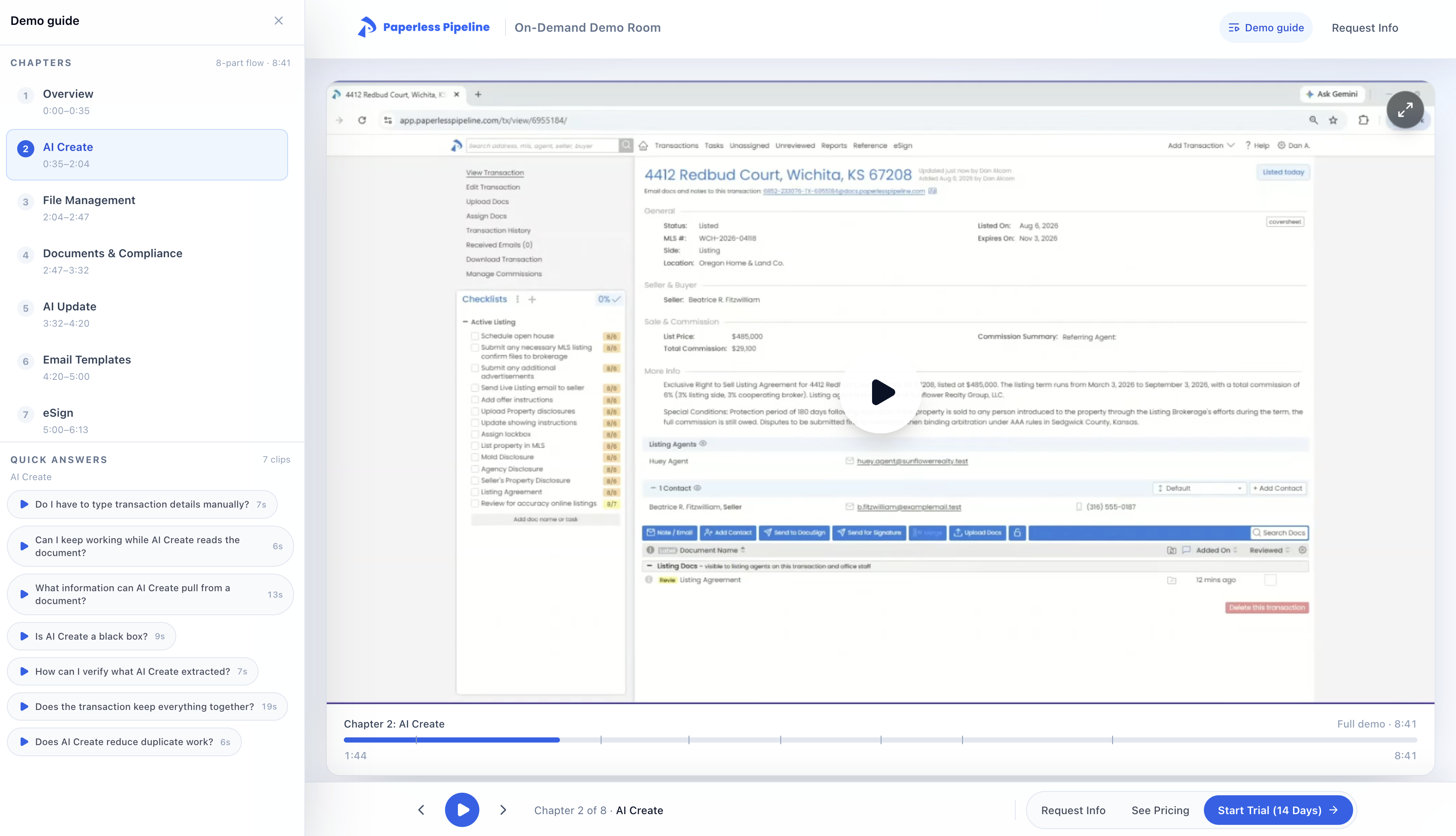
A production On-Demand Demo Room that lets buyers explore Paperless Pipeline on their own time. It combines chaptered proof, grounded AI Q&A, and a human handoff when intent is real.
GTM is the domain I know deeply. I connect acquisition, buyer evidence, product usage, sales, support, churn, and media into tools leaders can trust and teams can act on.
I turn scattered product, sales, marketing, support, churn, and call data into an operating view with visible evidence behind every recommendation.
I ship production tools with Claude Code, Codex, Lovable, and modern APIs: demo rooms, decision surfaces, workflow automation, and research harnesses.
I connect CRM, product usage, billing, transcripts, customer support, and Google, Microsoft, OpenAI, Meta, and LinkedIn media into one usable system.
I own the web and measurement loop: AEO/SEO, landing pages, paid acquisition, calculators, and experiments that move prospects toward activation.
I convert demos, onboarding calls, and support conversations into traceable evidence that improves messaging, product decisions, and the buyer experience.
A decade in B2B SaaS revenue gives me the operating judgment: 5,000+ demos, outbound systems, trial-to-paid instrumentation, and experiments that teams can run.
Two professional case studies lead. The shipped-work index underneath shows the range: systems, tools, and products I have taken from idea to live.
Short version first. Open the links when you want the build details.
Problem. The marketing site had traffic, but visitors still needed a salesperson to answer practical questions about price, savings, commission, and transaction process.
Build. Built four customer-facing tools: a pricing calculator, savings calculator, commission calculator, and transaction checklist generator.
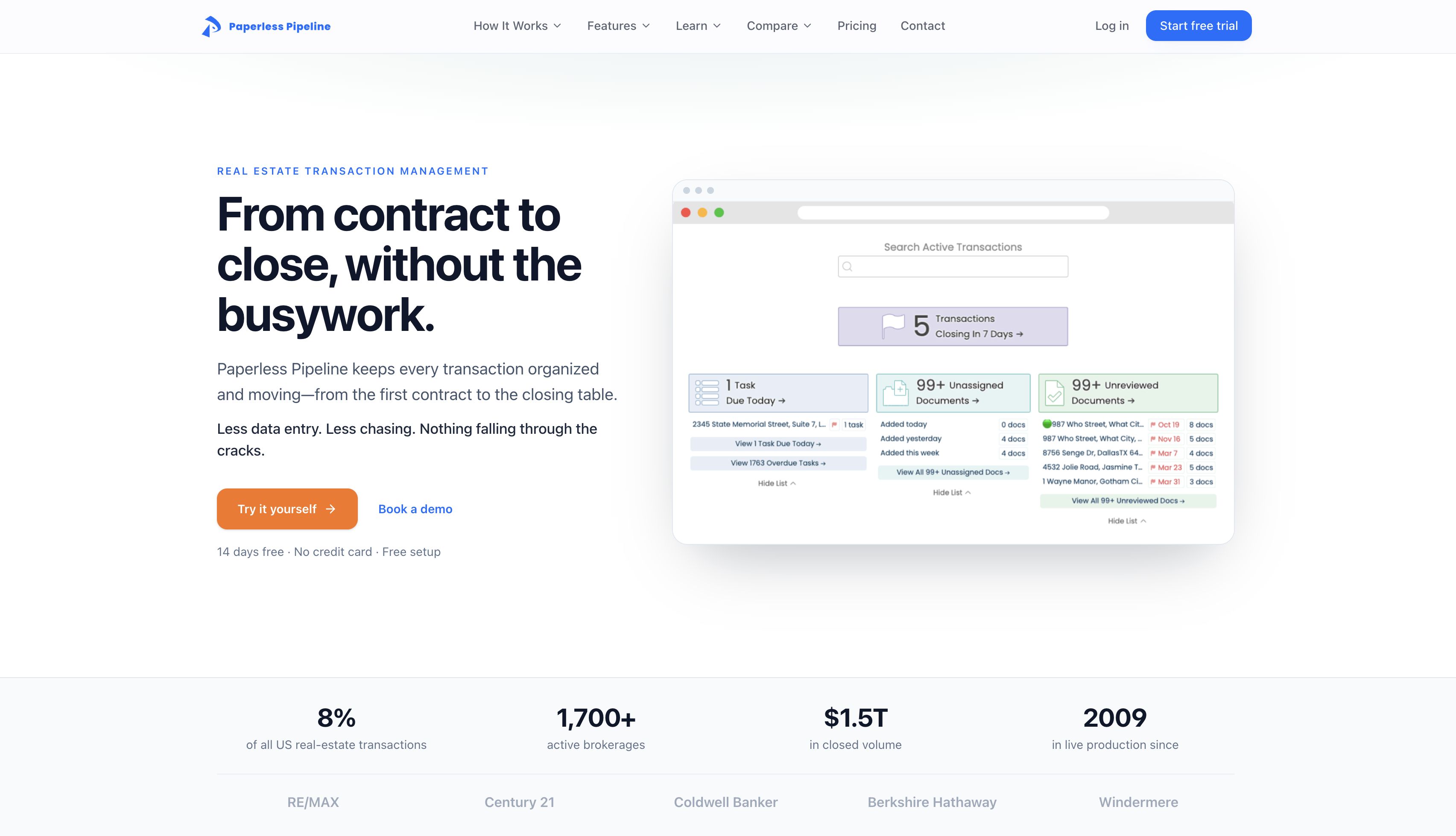
Outcome. The Lovable rebuild consolidated the marketing experience on www.paperlesspipeline.com.
Problem. Product usage, sales, marketing, churn, support, calls, demos, and paid media each told a partial story.
Build. Connected product, sales, marketing, churn, customer support, demo and call transcripts, plus Google, Microsoft, OpenAI, Meta, and LinkedIn ad data into a unified GTM data layer.
Outcome. Founder and leadership now have a faster, shared view of what is happening across the revenue system, what is driving it, and where to act next, with the evidence visible behind each decision.
Problem. Churn was being discussed as a current-period metric instead of a longitudinal business pattern.
Build. Analyzed 17 years of company churn data to compare churn behavior across time and isolate the recurring driver behind customer loss.
Outcome. Turned a long historical record into a clear retention signal leadership can use to prioritize product, customer, and revenue decisions.
Problem. Expired trialists represented a known reengagement opportunity, but there was no dedicated phone motion to work that segment consistently.
Build. Oversee an ISA phone department pilot using Apollo for lead workflows and JustCall for calling, follow-up, and activity tracking.
Outcome. Put a repeatable expired-trialist reengagement motion into pilot, with the process and tooling in place to measure what converts before scaling it.
Problem. Paperless Pipeline needed to move its revenue data from HubSpot into Attio and establish a cleaner CRM foundation for the next revenue-system workflow.
Build. Configured and ran the HubSpot-to-Attio migration, moving 90,885 records into the new CRM.
Outcome. Moved 90,885 records from HubSpot to Attio, giving the team a new CRM foundation for its day-to-day revenue workflows.
Problem. Partner-led acquisition was an untapped channel for reaching buyers already using adjacent B2B SaaS products.
Build. Built the affiliate channel through PartnerStack, identifying and organizing a target set of 50 high-relevance B2B SaaS products for partnership outreach and referral development.
Outcome. Put the partner channel infrastructure in place as a new acquisition motion, ready for partner recruitment, referral tracking, and performance measurement.
Problem. "What do customers actually say?" kept getting answered with anecdotes from whoever took the last call.
Build. Built a living Voice of the Customer audit from raw demo and onboarding transcripts.
Outcome. Created the VoC documentation that now informs website copy, email messaging, and product development.
Problem. Buyers had to wait for a calendar invite just to see the product, and most of that first call was spent on repetitive early-stage questions instead of real evaluation.
Build. A recorded walkthrough guides buyers chapter by chapter, an AI assistant answers questions from approved product docs within clear guardrails, and a human steps in the moment a buyer needs one.
Outcome. In production now.
Problem. AI work can produce a plausible answer while hiding the cost, the route it took, the evidence behind the change, and whether the output was worth the credits.
Build. I built Cairn as a provider-neutral runtime with a shipped Codex adapter.
Outcome. The local runtime and Codex adapter are running in daily use.
Problem. An hourly scheduler is not an autonomous builder if it only records that work should happen.
Build. Built the first live Auto Builder loop inside Cairn and StackSwap.
Outcome. Verified live on StackSwap: /what-is-fin-ai-agent produced a draft_ready cycle with an answer-first outline, GTM prompt-library CTA, anti-LLM editorial brief, and explicit SERP-provider fallback.
Problem. Comparing AI work across providers is difficult when evidence, quality, latency, retries, usage, and credits arrive in different shapes or disappear into a transcript.
Build. Built a durable local harness that replays the same task fixture across Codex, Claude Code, and OpenClaw-style receipts, normalizes the evidence, preserves unknowns, and produces verified-outcome, evidence-coverage, latency, retry, and pricing comparisons.
Outcome. 25 tests passed.
Problem. Most teams inherit a GTM stack they cannot explain.
Build. Built and shipped a library of 125 free operator prompts for real GTM work: research, positioning, outbound, discovery, pipeline, pricing, RevOps, and AI-assisted systems building.
Outcome. StackSwap is live as a free GTM workbench where founders and operators can copy a prompt, adapt the assumptions, and move from a blank page to a useful working artifact faster.
Problem. Most teams can prototype an agent but lack a repeatable way to test it.
Build. Created a standalone StackSwap prompt that guides operators through repeatable task setup, acceptance criteria, independent verification, evidence logs, retries, cost, latency, scoring, variability, and task-specific recommendations.
Outcome. Live on StackSwap.ai as a copyable starting point for teams building their own evaluation harness.
Problem. Most teams treat AI visibility as a copy problem.
Build. Built the AEO audit to inspect raw HTML, crawler access, structured data, answer-ready content, entity authority, and the AI surface.
Outcome. The audit moved Paperless Pipeline from 33 to 98 out of 100 after the Lovable rebuild, with the proof card, diagnostic detail, and implementation checklist all generated from the same StackSwap workflow.
Problem. Revenue teams run on scattered tools: a CRM that doesn't know who's actually a fit and outbound that doesn't learn from past wins or losses.
Build. A full GTM operating system: a Today dashboard with a prioritized action queue, a Relationships database with ICP fit scoring, AI-powered lead generation that trains on your wins, and an Intelligence layer that feeds context to every AI action.
Outcome. Shipped an end-to-end SaaS revenue intelligence product: a live operating system for prioritized action, account intelligence, AI-assisted lead generation, and revenue context.
Problem. Aged inventory sitting priced below dealer cost, and no site built to move it before the next brief could even be scoped through an agency.
Build. The client sent the brief in the morning.
Outcome. Live at pnwtruckdeals.com, clearing aged inventory the same week it shipped.
Problem. A 1,500-piece Cardano collection needed a deterministic way to generate and distribute rarity on-chain.
Build. Coded the procedural generation pipeline and RNG rarity distribution engine, then handled the collection's launch and distribution directly.
Outcome. 1,500 CNFTs sold out in two weeks, generating $33,000 in revenue.
“Your genius on strategy lights up my heart, and we are having our biggest new customer month yet from your drive.”
“Nick is one of those people you NEED on your team… he has a strong sense of urgency and knows how to communicate and position himself with both prospects and clients. In 6 months as a BDR manager, we doubled our demo numbers. If you're looking for your next hire, Nick is your guy.”
At 19 I was trained on Air Force / Boeing troubleshooting trees. You don't guess at a fix. You trace the failure to its source, find the leverage point, and rebuild. That's the through-line from aircraft maintenance to sales, GTM, RevOps, AI, and software. I've held nearly every seat and gone 0→1 more than once, which lets me see both the whole system and the individual failure point.
Pipeline, outbound, RevOps, attribution. I've run the motion and rebuilt it, so I know which problems are real and which are noise.
Full-stack products built with AI-assisted workflows, then shipped, deployed, and instrumented.
AI as infrastructure around a workflow, focused on the work where it earns its keep.
Forecasting, cohort analysis, unit economics. The numbers behind the story, made trustworthy.
How data, tools, teams, and incentives connect, and where the friction actually lives.
The buying committee, the org chart, the handoffs. Most “strategy” problems are really systems problems.
Production web apps, revenue systems, and AI-native tooling from the interface to deployment.
I'm interested in full-time remote roles where I can own the connective tissue between demand, product, sales, data, and revenue—and keep building the systems myself.
nick@stackswap.ai